
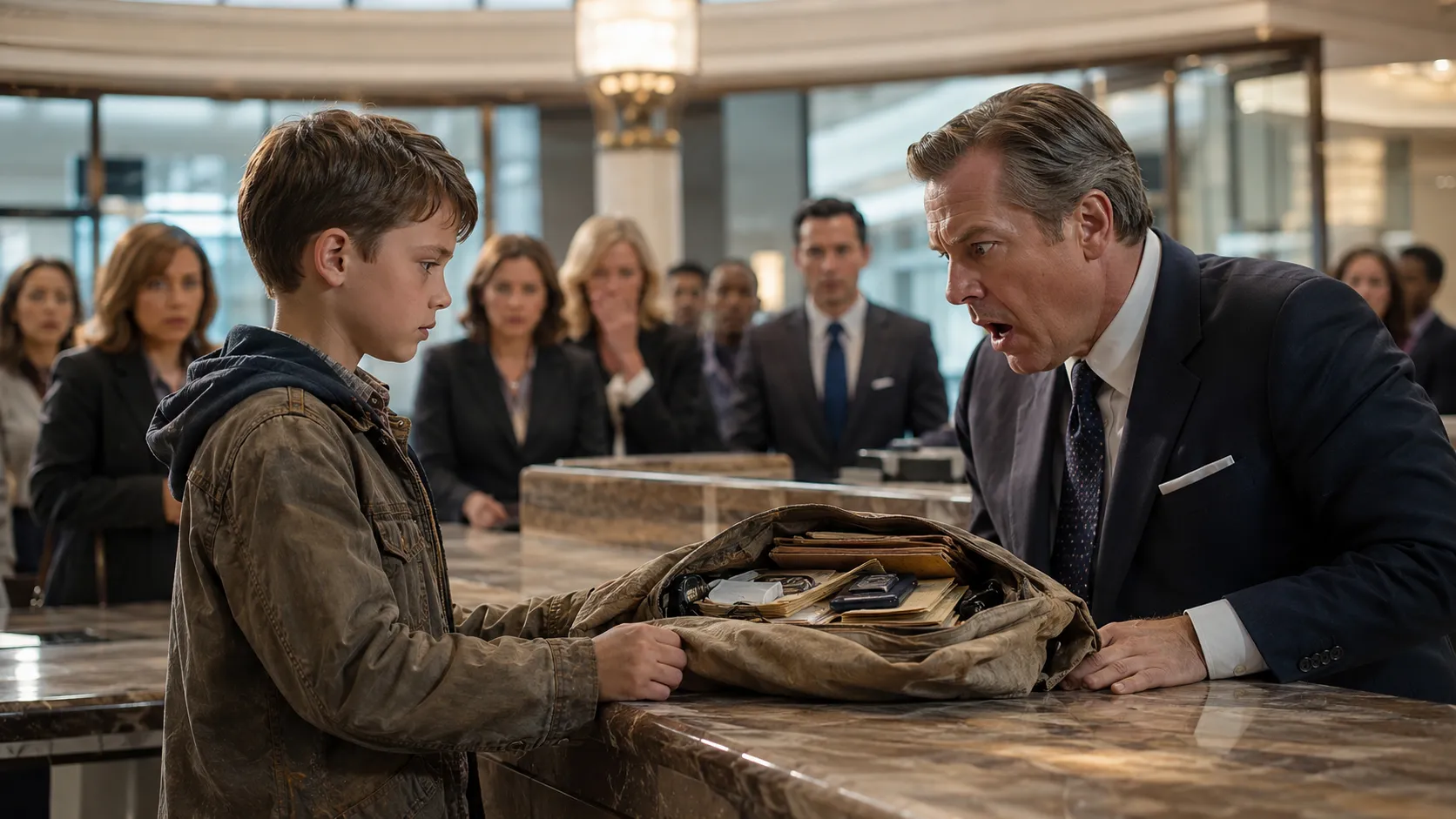
Evan walked into the bank with torn shoes and a threadbare cloth bag, and everyone thought he was a beggar. But when the manager saw what was inside, his face went pale — because the boy was carrying proof of a crime the bank had buried for six years.
The laughter began the moment Evan Cross pushed through the glass doors of Hawthorne & Pike Bank.
He was twelve, thin, and wearing a jacket that hung loosely from his shoulders. His shoes were worn almost flat, and in his hands he carried an old cloth bag with fraying seams.
The security guard stepped toward him at once.
“This isn’t a shelter,” he snapped.
Several employees looked up from their desks and smiled with quiet contempt. Customers turned away, pretending not to notice.
But Evan did not beg.
He did not cry.
He walked to the counter, placed the cloth bag down, and slowly opened it.
At first, it looked like trash: old envelopes, loose papers, a cracked leather pouch. Then something metallic caught the light.
Dozens of key fobs.
Confidential documents.
And a bank transfer pouch stamped with Hawthorne & Pike’s own logo.
The branch manager, Martin Caldwell, stepped out of his glass office.
“What is this?” he asked.
Evan slid one document across the counter.
Caldwell looked down.
FRAUD INVESTIGATION: CASE 17-113.
His face lost all color.
Six years earlier, a contractor named Daniel Cross had been accused of stealing from the bank through hidden transfer loopholes. Before he could defend himself, he died in a hit-and-run. The case was closed quickly. Too quickly.
Daniel Cross was Evan’s father.
“My dad wasn’t the thief,” Evan said quietly. “He found the thief.”
The lobby went silent.
Caldwell brought Evan into his office and closed the blinds. The boy explained that a stranger had called him with instructions. If he wanted the truth about his father, he had to bring the bag to Caldwell.
Inside were safe-deposit keys, transaction logs, emails, and photos. They pointed to old accounts emptied through internal access codes.
At the bottom of one page was a name Caldwell had feared for years.
Marcus Hale.
Regional oversight.
A man now close to the top of the company.
Caldwell felt shame crawl up his spine. He had not stolen anything, but he had signed the final report because corporate wanted silence, investors wanted calm, and he had been afraid to lose his career.
He had helped bury Daniel Cross.
Before Caldwell could speak, his office phone rang.
REGIONAL OFFICE — HALE, M.
Caldwell answered.
“Martin,” Hale said smoothly. “I’m nearby. I’ll be there in ten minutes. I hear there was a situation in your lobby.”
Caldwell looked at Evan.
The boy whispered, “Is he the one who killed my dad?”
Caldwell did not answer.
Instead, he texted Emily, the head teller.
Call 911. Ask for financial crimes. Internal fraud evidence in my office. Do not let anyone speak to the boy alone.
Then he pressed the silent panic button under his desk.
Marcus Hale arrived early.
He walked in smiling, shaking hands with the same guard who had tried to throw Evan out. His suit was perfect. His voice was calm. But when he saw Caldwell blocking the office door, his eyes turned cold.
“Where is the boy?” Hale asked.
Caldwell stepped into the lobby.
Loudly enough for everyone to hear, he said, “Marcus Hale just asked me about unauthorized access to safe-deposit systems. I have reported it.”
The whole bank froze.
Hale’s smile vanished.
“You don’t understand what you’re doing,” he said.
Caldwell’s voice shook, but he did not lower it.
“I know exactly what I should have done six years ago.”
Police officers entered through the glass doors.
Evan stepped out from behind Emily’s desk, still holding the cloth bag. The same people who had laughed at him now watched in silence.
Investigators found what Daniel Cross had tried to expose before he died: a quiet network inside the bank siphoning money from dormant accounts and hiding the theft behind false transfer records.
Daniel had been framed.
Marcus Hale was arrested.
Evan and his mother were placed under protection. Caldwell was suspended during the investigation, then later cleared of direct theft.
But he did not pretend he was innocent.
Weeks later, he visited Evan with an apology.
“I should have listened to your father,” Caldwell said.
Evan looked down at the notebook Caldwell had brought him.
“Will it matter now?”
Caldwell nodded.
“It already matters. Because you walked in anyway.”
Evan looked toward the street.
“They laughed at me.”
“I know,” Caldwell said. “And I hope they remember it every time they think about what they almost helped hide.”
Evan held the notebook against his chest.
For the first time, he almost smiled.
Because his father’s name had not been restored by a rich man, a lawyer, or a boardroom.
It had been restored by a poor boy with torn shoes, a cloth bag, and enough courage to walk into a place where no one thought he belonged.