Aaliyah tried to explain that her braids protected a medical condition, but the teacher cut them anyway. Three days later, her military mother entered the school with a folder, a screenshot, and the truth no one could ignore.
Aaliyah Brooks sat in the nurse’s office with her hands clenched in her lap.
She was twelve years old, quiet, and careful — the kind of child who tried not to be noticed. Her long braids were not fashion. They covered the bald patches left by alopecia, a medical condition her grandmother had already explained to the school while Aaliyah’s mother, Captain Renee Brooks, was deployed overseas.
But that morning, Ms. DeWitt stopped her in the hallway.
“Those extensions violate dress code,” the teacher said.
“They’re medical,” Aaliyah whispered. “I have a condition.”
“I don’t care what your excuse is,” Ms. DeWitt snapped. “You’re not special.”
Minutes later, Aaliyah was sitting beneath the harsh light of the nurse’s office while Ms. DeWitt stood behind her with scissors and clippers. The nurse hesitated, but no one stopped it. Aaliyah’s best friend, Kiara, stood in the doorway, recording because something in her knew this was wrong.
The first braid fell to the floor.
Then another.
Then another.
Students gathered outside the small window. Some whispered. A few laughed. Aaliyah lowered her face as the protective style her mother had helped plan was stripped away in front of everyone.
By afternoon, the school had suspended Aaliyah for one day and released a cold statement: dress code had been enforced.
But Kiara’s video spread faster than the school could control.
Three days later, Captain Renee Brooks walked into Cedar Grove Middle School in full uniform.
The hallway went silent.
She did not shout. She did not threaten. She walked straight to the nurse’s office, where Ms. DeWitt tried to stand tall.
“We followed policy,” the teacher began.
Renee placed a folder on the desk.
“No,” she said. “You ignored it.”
Inside were Aaliyah’s medical diagnosis, emails from her grandmother requesting accommodations, and the district’s own policy stating that protective hairstyles and head coverings for medical conditions required support, not punishment.
Then Renee slid one more page forward.
It was a screenshot from a staff group chat, sent the morning Aaliyah was pulled from class.
Ms. DeWitt’s name was attached to the message:
“She’s hiding something under those braids. Watch her squirm when it comes out.”
The principal’s face drained of color.
Renee looked at him.
“My daughter was not disciplined. She was humiliated.”
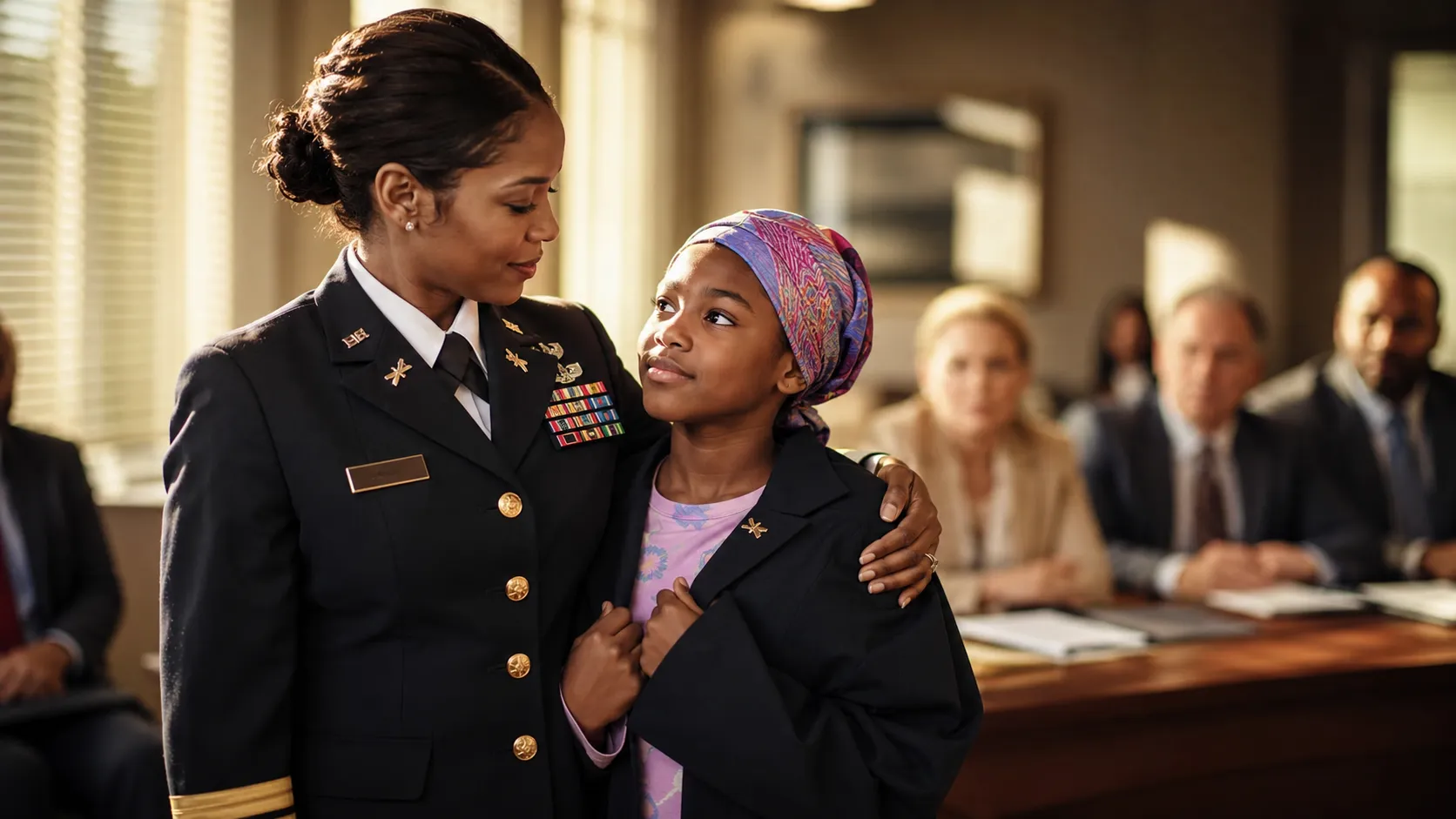
Aaliyah sat nearby with her hood pulled low, trying to disappear. Renee removed her uniform jacket and placed it gently around her daughter’s shoulders.
“Look at me,” she whispered. “You did nothing wrong.”
Aaliyah’s lips trembled.
“They laughed.”
Renee’s voice stayed calm.
“Some people laugh when they want power. That ends today.”
The school tried to handle it quietly. Renee refused. With a civil rights attorney, she demanded every email, nurse log, disciplinary note, and security recording. The district placed Ms. DeWitt on leave.
Then other families came forward.
One girl had been sent home repeatedly because her natural hair was called “unkempt.” Another student with a scalp condition had been forced through humiliating checks. What happened to Aaliyah was not one mistake. It was a pattern.
At the school board meeting, Renee stood before the room with her documents arranged in order.
“My daughter had a documented medical condition,” she said. “The school knew. A teacher chose humiliation over accommodation. Then the school blamed the child.”
No one could spin the truth anymore.
The board ordered an independent investigation, staff training on medical accommodations and hair discrimination, and a new rule: no staff member could cut, shave, or alter a student’s hair under any circumstance.
Ms. DeWitt resigned. The district issued a public apology.
But the most important moment did not happen in front of cameras.
It happened weeks later, when Aaliyah returned to school wearing a soft headwrap that matched her favorite hoodie. Kiara held her hand. A new teacher greeted her gently at the door.
“I’m glad you’re here,” she said. “If anything feels wrong, we handle it together.”
For the first time in weeks, Aaliyah’s shoulders relaxed.
Healing was not instant. Some days she still wanted her hood. Some days she cried without warning. But slowly, she stopped feeling ashamed of what had been done to her.
One afternoon, while shopping with her mother, Aaliyah picked up a bright scarf and smiled.
“I want this one,” she said. “It’s loud.”
Renee smiled back.
“Loud is fine.”
Then Aaliyah looked up.
“Mom… was I brave?”
Renee blinked away tears.
“You told the truth when adults tried to make you small. That is bravery.”
Aaliyah’s hair was never the thing that defined her.
Her courage did.